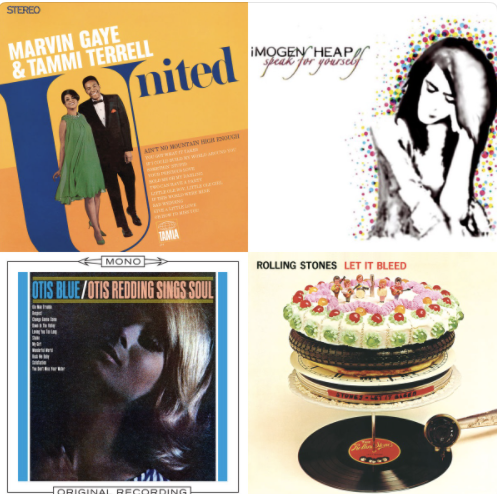

7. Song:Ain’t No Mountain High Enough
Artist:Marvin Gaye & Tammi Terrell
Album:United
Imagine a song so jubilant, so effervescently joyful that the mere echoes of its chorus in the title of another song grants that song immortality. I’m of course talking about the song “River Deep-Mountain High” by Ike & Tina Turner. Don’t snicker, I truly believe that, in the process of compiling the various lists of great songs that it appears on, it has snuck onto those esteemed publication’s rosters by people simply misremembering which song they were supposed to vote for. Remember “Ain’t no mountain high enough/ Ain’t no valley low enough/ Ain’t no river wide enough”. Cough. “River Deep-Mountain High” is a lumbering mess in comparison to this shooting star of a song, one that doesn’t deserve to be anywhere near the level of accolades that “Ain’t No Mountain High Enough” should have received in its place. Especially so since its output represents Tammi Terrell’s greatest contribution to the Motown sound.
The way that she and Marvin Gaye tackle the material is wonderful to behold. They both are clearly giving it their all, sweating through some marvellous vocal leaps together. “If you ever need a helping hand/ I’ll be there on the double/ Just as fast as I can” they both belt, as if nothing else but their love could possibly matter. Producers Johnny Bristol and Harvey Fugua can barely keep up with the dynamic duo, layering all of the classic Motown elements in a futile effort to contain their vitality. Strings both plucked and vibrato’d, oodles of percussive details, ringing harp glissandos, all to craft an atmosphere where vigor and the power of love wins the day. The partnership of Marvin Gaye and Tammi Terrel was so exuberant that its ultimate tragic end lends a bittersweet quality to the proceedings, even if the joy ends up overpowering it in the end. Like a life lived to its fullest, with no room for regrets.
“Remember that day/ I set you free” Thinking back to when this song was featured prominently in Remember The Titans, the story of how a high school football team overcame racism, I am convinced that this is peak joy. So potent that it reaches across the romantic divide and simply calls for our common humanity to bridge petty differences. Countless songs have tried calling out humanity’s worst impulses, “Ain’t No Mountain High Enough” tries another way and calls out for our best impulses to take over. “If you need me call me/ No matter where you are/ No matter how far”. I mentioned it before on “Somebody That I Used To Know”’s blurb, but this song represents that song’s mirror image. With its comparatively lo-fi sound and ringing bells contrasting with that song’s more melancholic mood. It just goes to show the aftershocks of “Ain’t No Mountain”’s crystalline appeal, we’re still reaching for the contact high that it represents.

6.Song:Hide And Seek
Artist:Imogen Heap
Album:Speak For Yourself
We’ve had a lot of songs on this playlist capable of inducing what Lorde termed “Supercuts” in the listeners’ imaginations. The myriad of momentums induced, the chordal movements that tease us along to a climax of noise. Few have toyed with the structures that enable such moments of synesthesia, fewer still with only the singer laying bare their soul for the world to hear. “Hide and Seek” is the sparest, most stark, rendering of grief ever recorded. Imogen’s vocals, wrapped inside layers of vocoder effects, shoot straight at the heart of anyone wondering “Why?”. They are all we have. “Where are we?/ What the hell is going on?”. Anyone who has ever had to sit down and muck through intense emotional pain, from whatever source, can find a paradoxical sense of comfort here, where the intimacy of her hushed vocals reckon with mutual understanding.
“Hide and Seek” is not conventional, the closest we have are tone poems or the ultra spare folk/blues that were in vogue in the 60’s and 70’s. Even those feel hemmed in by convention. With nothing but Imogen’s roiling synthetic vocal layers and a light touch of synths near the end, she carries us along through three distinct movements, each section distinct but inseparable. We have that famous “chorus” near the end, but that precedes a faltering fadeout section ”“you don’t care a bit”. The opening verses are expertly crafted in the ways that they invoke the lost comforts of happier times “Oily marks appear on walls/ where pleasure moments hung before/…the sweeping insensitivity of this/ still life”. The meme-ification of the second movement only proves that song has purchase in any intensely emotional moment, where fateful decisions can and do carry their consequences through the soul and present reflections.
“Mm, what’d you say?/ Mn, that you only meant well/ well of course you did” The way the vocoder layers conspire to overwhelm the listener, every inch of the stereo space occupied by the ever-shifting vocals. Even the way she shifts her singing style towards staccato during the end section allows for the layers to sound like accompanying snowflakes, here and then suddenly gone. On the album Details, from her band Frou Frou, near the end of the song “The Dumbing Down Of Love”, Imogen sings the following: “Music is worthless unless it can/ make a complete stranger/ break down and cry”. In the whole field of music’s rich history, there have been precious few songs that are consistent in delivering on that promise, as Oscar Wilde said “All art is quite worthless”. “Hide And Seek”, in its movements and moments, in its shifting tides of momentum and quiet release, comes the closest.

5.Song:Strange Fruit
Artist:Billie Holiday And Her Orchestra
Album:Gold: Billie Holiday
“Southern trees bear a strange fruit/ blood on the leaves/ and blood at the root” Opening with a somber trumpet and transitioning into a ghostly piano piece, here is a song that grabs you by the throat before Billie Holiday even begins to sing. Her voice is really what makes this version superior to all, it was originally performed as a protest song by its writer/composer Abel Meeropol, her reedy presence making every line drip with the metaphorical blood she sings about, dominating the proceedings, gliding over the subdued backing tracks like a ghost drifting in the wind. Little wonder that performances of this song required a totally dark room and a spotlight shone upon her, this was potent symbolism and music merging together into a gigantic shibboleth that demanded audiences attention back then and forever onward into eternity. “Here is a strange and bitter crop”.
Tracking down a version of this song suitable enough for inclusion was quite the effort. After listening to the many, many, versions available, I settled upon the recording on Gold: Billie Holiday. It has considerable hiss and numerous pops and crackles, but other versions based off of the 1939 recording had critical issues like even more pronounced hiss or degraded sound quality even when compared to the list version (eg:Billie Holiday 1957). One attempt to clean up the hiss resulted in a neutered song with less vivid dynamics (Billie Holiday 1988). Those who refuse to partake in old school vinyl audio issues can find some measure of comfort in Billie Holiday’s 1956 recording which brought the musical stylings in line with the period, but I feel that the 1956 version has none of the buried power of the original recording.
In a case of picking my poison, I chose the deeper, more nuanced version, the exalted original in all of its faded glory. There is something entombed within the crackles and pops, the hisses and skips, that screams across time. From the horns that sound like the heralds of a funeral procession, combined with spectral piano chords and haunting woodwinds, to the dynamic ways that each instrument surges and seethes underneath Billie’s brooding performance. “Strange Fruit” feels like an ancient myth but, because the subject of its lyricism is so recent and not outside the realm of living memory, it seethes with ghastly trauma. Like connecting with ancient writers, feeling their struggles and exertions through their writings. Billie Holiday’s power to transfer the horrors of racism in the American South into your headspace is not something any music lover can afford to forget.

4.Song:Change Gonna Come
Artist:Otis Redding/ Sam Cooke
Album:Otis Redding Sings Soul/ Keep Movin’ On
“I was born by a river/ In this little old tent/ just like this river/ I’ve been running ever since”. Every song has its context, precious few succeed beyond them. Growing up in an environment of hellish racism, borne out by the establishment in every aspect of American life, Sam Cooke composed this gem after being denied accommodation at a holiday inn in Louisiana. “It sounds like death” was Bobby Womack’s response to the record, “That’s what it sounds like to me” came Cooke’s rejoinder. It’s such a haunting, powerful record, one that moves along at a pace that can best be described as a funeral procession. The composition is structured so sweetly that it couldn’t have been anything but a soul record, and nobody who covered it afterward ever did it any justice within that genre’s framework. Syrupy sweet strings and airy production surround a game Sam Cooke, so why isn’t his version the main one on this list?
After Sam Cooke died, Otis wanted “to fill the silent void” created (I am quoting the wikipedia page directly, but honestly, the words are too good not to take note of wherever you find them). Fill it he did with this, his greatest performance. Otis’s version is the superior record, simply because he stripped down the production, pared it down to its essential edges, allowing the inherent soul of the composition to shine through the darkness. There are no syrupy strings, no airy reverberations surrounding the proceedings, just a fanfare of sparse horns and ghostly background pianos and drums. More specifically, the Mono record is the definitive way to experience the majesty of Cooke’s structures and Otis’s world weary performance. Everything centered in and around a voice that grits and grinds its way through the declarations, the howls against the injustices of the world.
“It’s been too hard livin’/ But I’m afraid to die” The great part of this record is how every element of it combines into a timeless proclamation. Anyone going through an existence of misery, of loneliness or hard living can use this song as a personal anthem, as a motivator to turn our personal hells into ladder rungs, inching us closer and closer to a vision of heaven on earth. However intimate you wish it to be, however large a cause you want to marshall its energies toward, “Change Is Gonna Come” is able to mold itself to your circumstances. “But there was a time that I thought/ Lord this couldn’t last for very long”. When the horns first kick in there is no reason but to feel a sense of togetherness, a celebratory air that our shared sufferings have motivated us, and can continue to, to strive for greater things, to consciously right the wrongs done to us and others. After all “It’s been a lo-oo-ong time coming/ but a change has gotta come”.

3.Song:All Along The Watchtower
Artist:The Jimi Hendrix Experience/ Bob Dylan
Album:Electric Ladyland/ John Wesley Harding
From the very opening guitar chords, strummed as if they are pouring gasoline on to kindling, through to the guitar solos that set those piles alight, Jimi Hendrix’s rendition of “All Along The Watchtower” strikes a revolutionary chord, in tune with all the chaotic inhibitions of humanity, of society. Those acoustic guitar chords continue ringing throughout the rest of the song, with a layer of tape distortion that laces them with an unnerving variability, like they are choruses for the damned. “There are many here among us/ Who view that life is but a joke” Hendrix sings, his voice clear in the mix, leaving us cryptic clues as an answer to some unknown prayer. No wonder this song played so well as part of that Vietnam War sequence in Forrest Gump, it was a perfect accompaniment to that darkest of wars, the black-hole gap in human morality that leads to young boys killing each other in the jungle for the benefit of out-of-touch elites.
For sure, Hendrix was working off of material written by that master of sphinx-like poetry, Bob Dylan. He who wrote the song but will not reveal the whys and hows of its particulars. This meant that Hendrix had to re-write the music to better fit the world of wars that he knew was at the core of this song’s personal interpretation. Where Bob’s version relied on the acoustic guitar for the main driving impetus, his voice providing the caustic fuel that Jimi knew he had to capture by other means, The Jimi Hendrix Experience had a power trio. Hendrix on electric guitars and vocals, Mitch Mitchell on drums and Dave Mason on those 12-string acoustic guitars. For all the buried power inherent to the best of Dylan’s work, this is one of those songs that demands the full power of a rock band propelling its satanic majesty. And Bob Dylan would end up agreeing with this assessment, as he plays Jimi Hendrix’s version at his live shows to this day.
Dylan ceding mastery of his material like this should speak to how great it is by itself, six decades of revolutions in recording technology and processes have revealed how masterful it remains. Consider how Hendrix’s solo guitar peels around the stereo field, as if demanding your attention no matter where it strays off to. What would be considered a gimmick today is a point in its favour, as the music industry and production techniques have become more and more stratified, its ghostly residues are still a testament to Hendrix’s instincts as a producer/composer. “But you and I have been through that/ and this is not our fate” Even despite the song’s apocalyptic energies, where despair hangs around with confusion and egotism as a common thread for humanity, there is a thrilling exuberance to “All Along The Watchtower” that only the greatest supernovae talents can provide.

2.Song:Stand By Me
Artist:Ben E. King/Playing For Change
Album:Don’t Play That Song /Playing For Change
At 3:02 long, “Stand By Me” manages to stand tall as the perfect pop-song, as confident in its delivery as it is concise in its runtime. As luminous an example of the type of soul that Motown would produce over the next decade that would ever be made. And for some reason his band The Drifters decided to pass on it! Sure, they didn’t have the benefit of hindsight that we have when listening to the fully recorded and arranged song, but someone should have knocked some sense into them. This is why Ben E.King went solo, some people just can’t be helped, even if salvation is staring them right in the face. Working with Jerry Leiber and Mike Stoller to fill out the lyrics, taking some light inspiration from a Sam Cooke spiritual “Stand By Me Father”, this enlightened construction just breathes natural charisma, like you can’t possibly tear your ears away from it.
It all starts with that bassline to end all basslines, something so simple and catchy that it’s a miracle that nobody else had cribbed it first. Lloyd Trautman’s performance here is exemplary of the studio musician’s craft, perfect precision work that illuminates all around it. The triangle and gourd scratches that accompany it for the first two bars twinkle with reverb that reaches across the stereo field. Then Ben E. King comes in “When the night has come/ And the land is dark”, reverb bouncing off of his voice, like candle light flickerings beckoning the listener toward hope. “Oh, I won’t be afraid/ Just as long as you stand, stand by me”. The structures are so simple, yet enlivening as strings and choral vocals enter the mix, climbing up and down the scales with a syrupy sweet cadence. Eventually King’s vocals take a break as the volume of the instruments shoots up, like watching a shooting star flit across the sky, or fireworks spark skywards.
The potent spiritual power of this song is such that innumerable covers have sprung up since its release. To my ears, the one that best captures its latent power to bridge the divides of culture and enmity is Playing For Change’s version. In a globe-trotting performance, a true unity of purpose is achieved as differing musical styles find themselves adhering to “Stand By Me”’s sweet structures. Everything from Native drum circles, to african tribesman chants, to bluesy folk-vocalists join in on this most luminous parade of humanity’s beautiful facets. It’s fitting that this most ageless of songs has its roots in the bible, specifically Psalm 46 on the lines “If the sky we look up/ Should tumble and fall/ Or the mountains should crumble to the sea”. As that tome speaks through the ages with its parables and commandments, so too shall “Stand By Me” speak to everyone for all time.

1.Song:Gimme Shelter
Artist:The Rolling Stones
Album:Let It Bleed
As we finally get to the #1 position, I’d like to reflect on a few things. For one, sharp-eyed readers will have noted that The Rolling Stones only make four appearances on this playlist, and those solely in the top 100. There’s good reason for that; always seeming to be a band teetering on the knife edge of quality, they are either the greatest rock band in the world, or they are not. Here, on “Gimme Shelter”, they are the greatest, everyone else is not. Two, keeping that dichotomy in mind, the breathtaking scope of musical textures, lyrical themes and volume fluctuations had to culminate somewhere. Like the flames at the top of flare-stacks, all of the lessons I have learned in researching this playlist, all of the hopes and heartbreaks, the curious momentum that great music instills in the listener, all of this finds its ultimate release here. This haunting, gorgeous, run-ragged record.
“Ooh, a storm is threatening” There is an audible froth, a boiling undercurrent, to this record. With Billy Hyman’s bass thundering along, some maracas and ratchety guiro play as firecracker detail, Charlie Watts on the drums centers a roiling storm. His jazzy drumming style, unshowy but spectacularly serious, boils over in the chorus. At “War, Dear!/ Is just a shot away/ Is just a shot away”, his precision strikes are what de-escalate the riotous emotions. Producer Jimmy Miller, at the height of his powers, allows the dark momentum its space to breathe among the chaotic mix. Even with an onslaught of additional elements; rollicking pianos, Mick Jagger singing lead vocals and tapping in with a harmonica solo, as well as Keith Richards rhythm guitars crowding in, there’s a beguiling clarity to it, a kind of chaotic purity, like A rough-hewn diamond.
But all of this wouldn’t have pushed this song to the mountaintop without two elements, Mary Clayton’s extraordinary vocal performance and Keith Richards lead guitars. Those shimmering notes that lead us in are stunningly gorgeous, unforgettably cinematic. The bluesy muscularity laced throughout the rest of the song arrives with a blue flame incandescence. Clayton’s performance soars over the proceedings, even managing to audibly astonish the group (a “Whoo” at 3:02) as her voice breaks with intensity on the lines “Rape, Murder/ It’s just a shot away”. Sadly, Clayton would lay the blame for her miscarriage afterwards on the strain she put herself through in the studio. That’s the lesson here; As Mick Jagger and Clayton duet over the outro, the lines that divide us are bridged. Through all the darkness and conflict inherent to human nature, under the weight of oppressive strain, “I tell you, love, sister/ Is just a kiss away”.
Afterword
So what have we gleaned from this experience? There are certainly a lot of lessons that can be pulled from the creation process, foremost is just how much work it actually is to compile the list, write 500 blurbs and collate the various statistics. Now I admit that it took a bit of chronic depression and anhedonia for the process to stretch as long as it did, this is partially why the cutoff date I imposed on myself looks better with each passing day, but I was continuously listening out for great tracks to add to its potent mixture. I still am for the revised list after 2030. If it is necessary.
Speaking of, my liberal attitude towards great songs needs some explaining as well. I’m sure you’ve noticed that the list has more representation from recent decades than almost any other top 500 songs list out there. While the 60’s are indeed a great decade for music, being in second place on most represented decades at 84 songs, there was always a sense that other lists of this magnitude depended on the 50’s/60’s/70’s entries being this effervescent fountain of youth that would always overshadow anything that came after. I think it’s safe to say that this playlist represents my displeasure with that mindset. I firmly believe that clinging on to the notion that songs from any decade cannot be bettered by artists releasing later on is musical terrorism, explaining a lot as to why music debate has retreated into clusters of indifference rather than shared communion.
Yes, eventually, some far off future version of this playlist will no longer have a song by the Beatles, or Frank Sinatra, or even later artists of note like U2, the math simply requires it to happen. Or else why should anyone bother trying to make great music again? By my estimate, a rolling average, I expect the decade of 2020 to 2029 to contribute at least 50 entries onto a future revision. This will require some tough choices to be made as to what songs get stricken off . That is not to say that great music of the past has stopped being great, merely that those particular instances have been surpassed in notions of quality and/or vital context. I’m sure you must think that I have abandoned such crucial factors when writing the blurbs that populate this endeavour, I disagree, I have simply evaluated most songs on their vital moment of the listening experience plus their still valuable context in the wider world of today, right now. It is as it should be.
The fact that this playlist is, in fact, designed to be a playlist is another thing that deserves mention. I designed it so that any given listener could hit shuffle and not hear a noticeable dip in the quality of songs. While I am quite sure that the top 100 or so have an audible oomph to them that separates them from one in the 500-400’s rankings, the difference should not be so drastic as to cause conniptions amongst any music lover’s delicate sensibilities. It’s almost as if 500 of the greatest songs of all time should actually sound like they are the greatest, rather than some random product of someone’s sexual awakening on a dancefloor that no one else can possibly perceive with just the music itself, or some Boomer’s drug addled obsession turned quasi-monument to all of “the good old days of rock”.
I was actually warned by some forum members of the Advance Wars By Web site that aiming for 500 songs was too much for one person to do. 200 at most was their advice when I was canvassing for songs, as that seemed to be the upper limit of collated lists that had written blurbs by a single person. I persevered through quite a lot of personal turmoil and poverty to be able to gift this collection of joyous noise to the world, my shout across time and space as it were. I’m not so arrogant as to believe that my opinions expressed throughout have more merit than yours or even the esteemed staff writers at music publications, I will express confidence in my methods though. I have brought together all of my skills as an audio school graduate, hobbyist writer and music devourer into this one gigantic effort. I express my fondest hope that you will continue to find inspiration in its contents.
If you would like to listen along, here is a link to the Apple Music playlist and the Spotify Playlist.
Index Part 1: Foreword, Part 2: 500-476, Part 3: 475-451, Part 4: 450-426, Part 5: 425-401, Part 6: 400-376, Part 7: 375-351, Part 8: 350-326, Part 9: 325-301, Part 10: 300-276, Part 11: 275-251, Part 12: 250-226, Part 13: 225-201, Part 14: 200-176, Part 15: 175-151, Part 16: 150-126, Part 17: 125-101, Part 18: 100-76, Part 19: 75-51, Part 20: 50-26, Part 21: 25-8, Part 22: 7-1 And Afterword